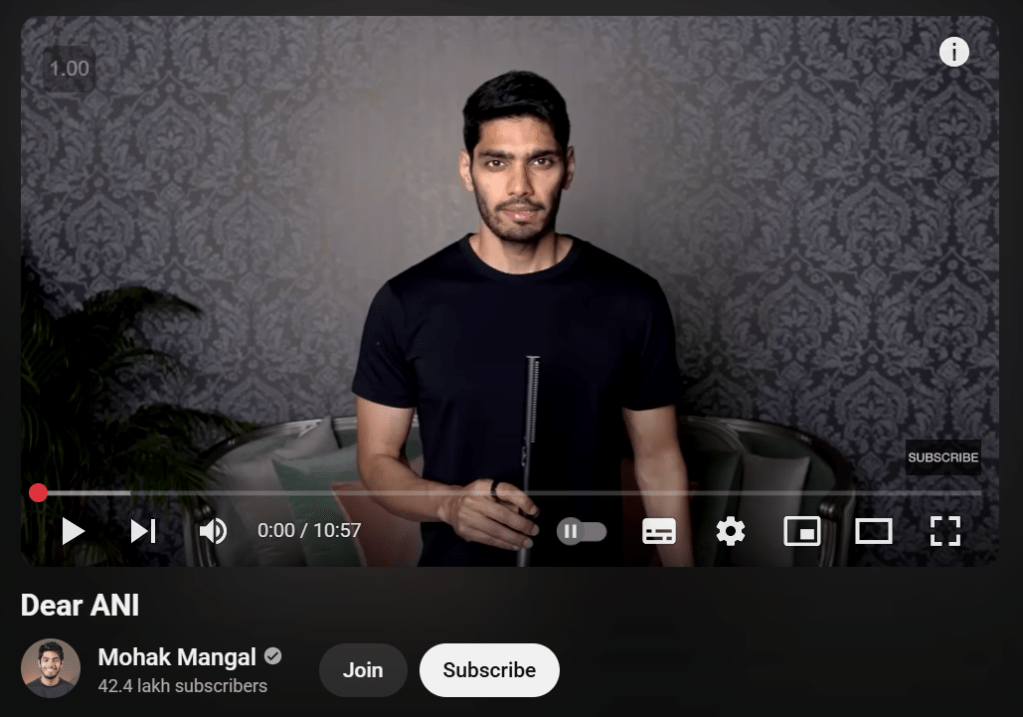
In a recent and intensifying controversy, several Indian YouTubers have accused leading news agency Asian News International [“ANI”] of using copyright enforcement tools not merely to protect its content but to strong-arm creators into paying hefty amounts under the threat of YouTube channel termination.
While ANI claims it is asserting its legitimate intellectual property [“IP”] rights and is fairly seeking compensation for use of its copyrighted material, creators argue that their usage of the footage falls under fair dealing and that ANI’s actions amount to extortion.
This blog takes a closer look at the legal tangle and asks: Is ANI enforcing its rights, or gaming the system? Has Mohak Mangal infringed ANI’s copyright?
The What: The Dispute in a Nutshell
What’s ANI being accused of, exactly?
According to public statements by creators like Mohak Mangal, ANI has been issuing copyright strikes on YouTube for the use of short news clips, sometimes lasting only a few seconds. For example, Mohak stated that the first strike came from an 11-second clip used in a 16-minute-long video, and a second strike came from a 9-second clip used in a 38-minute video.
After issuing the strikes, creators are reportedly contacted by ANI’s representatives and asked to pay between ₹1.5-5 lakh per strike as a retrospective license fee, in exchange for the withdrawal of the strikes.
Why does this matter? Because of how YouTube’s “three-strike” rule works.
What is YouTube’s three-strike policy?
In addition to Community Guidelines strikes – which are basically YouTube’s rules of the road on how to behave on the platform – the platform also enforces copyright strikes. These happen when a content owner submits a legal request to remove your video for using their copyrighted material. YouTube checks the request, and if it’s legit, the video is taken down to comply with the law of copyright.
Here’s how the policy plays out:
- Strike One: A warning shot. You lose some features for a week.
- Strike Two: A bigger red flag. Two weeks of restrictions, and your channel is on thin ice.
- Strike Three: You’re done. Your entire channel – videos, subscribers, history gets deleted.
This system is meant to deter repeat infringers. But here’s the twist: it can also be used as a pressure tactic. Critics argue that ANI’s representatives are weaponizing this system – using the threat of strikes and channel deletion to corner creators into paying up. With no real appeal system and the risk of losing years of work, creators are often left with no practical option but to pay. Many feel they’re being forced to pay under duress, regardless of whether their use actually counts as infringement.
What is ANI’s side of the story?
“As the exclusive copyright holder of its content, ANI has the sole legal right to communicate its work to the public or license its use. Enforcing these rights through mechanisms like YouTube’s copyright policy or legal action is not extortion. It is the lawful protection of property, as guaranteed by copyright law. Anyone disputing our rights is free to seek legal recourse,” ANI said in a statement to the Reporter’s Collective.
Following the viral spread of Mohak’s video, ANI has initiated a defamation lawsuit against him in the Delhi High Court. The court ordered Mohak to take down specific mentions of ANI, which he has done. Separately, ANI has filed another lawsuit accusing him of unlawfully using and reproducing ten of its videos on his channel and even using ANI’s logo without permission.
The How: A Legal Lens
How does fair use work in the U.S.?
The U.S. adopts a more flexible “fair use” doctrine under Section 107 of its Copyright Act, 1976, which allows for the reproduction of copyrighted work to a certain degree (often limited), in order to protect public interest, while balancing the rights of the holders. It is non-exhaustive and evaluated on a case-by-case basis using four fairness factors:
- Purpose and character of the use (whether it’s commercial or transformative);
- Nature of the copyrighted work;
- Amount and substantiality used;
- Effect on the potential market or value of the work.
Because of this flexibility, U.S. creators have a broader defense under fair use than Indian creators do under fair dealing, especially since “transformative use” is explicitly recognized and developed in American case law.
How does fair dealing work in India?
India, on the other hand, follows a stricter “fair dealing” doctrine, codified under Section 52 of the Copyright Act, 1957. This lays out a specific list of scenarios, like private research, criticism or review, reporting of current events, education, or judicial proceedings, where copying isn’t considered infringement. Unlike fair use, this list is exhaustive, not illustrative. That means if your purpose isn’t on the list, you’re likely out of luck.
In practice, the lack of clear legal guidelines on permissible usage and on fair dealing means its application often hinges on case-by-case judicial interpretation such as whether a 10-second clip in a 20-minute analysis qualifies as fair dealing.
Fair dealing in India does not permit full reproduction of content but the use of brief excerpts accompanied by commentary, criticism, or for news reporting is generally considered non-infringing. The creators claim their use of ANI’s footage within these legal limits.
How are they different? Fair use v. Fair dealing
Let’s take a landmark U.S. case as an illustration. In Campbell v. Acuff-Rose Music, Inc.1 from 1994, the rap group 2 Live Crew created a parody of Roy Orbison’s 1964 hit “Oh, Pretty Woman.” They used the song’s distinctive bassline and opening lyrics but altered the rest of the track to include humorous and sexually explicit content. Despite being denied permission by the copyright owner, Acuff-Rose Music, 2 Live Crew released the parody commercially. The U.S. Supreme Court ruled in favor of 2 Live Crew, holding that the parody constituted fair use, as it was transformative, offered social commentary, and did not harm the original song’s market. The Court emphasized that even commercial use could qualify as fair use if it added new meaning or expression.
In contrast, under the Indian Copyright Act, 1957, this use would likely not be protected as fair dealing. India’s law permits fair dealing only for specific purposes. Parody and satire are not explicitly recognized as fair dealing. Moreover, Indian courts interpret fair dealing more conservatively, often requiring that the copied portion be minimal and the purpose closely aligned with the listed exceptions. Therefore, a commercial parody like 2 Live Crew’s, even if transformative, would likely constitute copyright infringement in India.
Applying the Law to Mohak Mangal
Mohak’s videos typically explain policy issues, critique media narratives, or offer political commentary – using small clips of ANI footage to make a point or set context.
If we were in the U.S., this kind of use would likely qualify as fair use in my opinion because:
- It’s transformative – adding commentary and new context;
- It’s made in the public interest;
- Only brief clips are used;
- It doesn’t hurt ANI’s market for the footage.
Under Indian law, things are murkier. But in my view, Mohak has a shot under the “criticism or review” exception in Section 52(1)(a)(ii). Let’s run it through the Indian three-factor test, which was evolved in Civic Chandran v. Ammini Amma2 [“Civic Chandran”]:
- Purpose of use – Was it criticism/review or commercial gain?
Mohak’s content consists of explainers and critiques of policy or media narratives. Even though his videos are monetized, Indian courts (like in Civic Chandran) have held that monetization alone doesn’t negate fair dealing, especially when the primary intent is educational or critical.
- Extent and substantiality – How much was used? Was it the “heart” of the work?
Mohak used 9-11 second clips in 16-38 minute videos. Under the de minimis principle (though not codified in Indian law, it has been judicially invoked), trivial use that doesn’t capture the essence or marketable core of the original is not infringement. Since the use is both short and supplementary and not central in the present case, this factor supports him.
- Market effect – Did it substitute the original work or harm ANI’s business?
His audience watches the videos for his commentary and not the ANI footage. Hence, there’s little market overlap or substitution. This strengthens the case that it doesn’t affect ANI’s business value.
Therefore, in all three factors, Mohak is well-positioned. However, his defence is not bulletproof either. ANI’s arguments are not frivolous – they rest on the ambiguity of Indian copyright law, the narrow reading of exceptions, and the fact platform enforcement favours rightholders.
ANI could potentially argue that Mohak is not actually critiquing or reviewing ANI’s footage but is using it as background material. For instance, if he uses a video of a minister speaking on healthcare, ANI could say that he is not reviewing or analysing the ANI footage but using it as a narrative device. If Mohak then tries to claim that he is reporting current events, which is a mentioned purpose under fair dealing, ANI may argue that his videos are opinion-driven content and not neutral reporting of ongoing events (courts in India interpret “reporting of current events” narrowly). ANI could also argue that though the used clips are brief, they are deliberately chosen and repeated across multiple videos. Deliberate reuse implies editorial intent and reliance, and hence, may not fall under fair dealing. Lastly, ANI may claim that even short clips of their content can substitute their value, especially on a platform like YouTube where attention span of the user is short, because then the users may not visit ANI’s own platform.
The Copy That! View
This ANI v. YouTubers dispute sits at a complex intersection of copyright law, creator rights, and digital platform dynamics.
Legally speaking, ANI is within its rights to enforce copyright over its content, and to seek compensation where its works are used without authorization. From a statutory perspective, asserting these rights through YouTube’s copyright tools or even the courts is not inherently unlawful.
Alas, legality is not the same as ethics. While ANI’s actions may not meet the legal threshold for extortion, the optics and power dynamics raise concerns. Threatening creators with takedowns and steep fees for minimal, non-substitutive clips used in critique creates an ecosystem of coercive licensing. This chilling effect discourages public interest commentary and disproportionately impacts smaller or independent creators.
To address this imbalance, reforms are needed such as clearer statutory guidance on digital fair dealing, and platform-level changes like neutral, expert-reviewed counter-notice mechanisms. Until then, “pay or perish” may remain a grim but lawful reality for Indian content creators navigating legacy media power in the digital age.
Coming to Mohak’s case, while his use fits the spirit of fair dealing, in the absence of clear legal standards, it is the court’s perception that could tip the scale. Additionally, even if his defence stands in court, YouTube’s enforcement doesn’t always wait for a legal nuance and may take down the content anyway. His case is a strong example of transformative and proportionate fair dealing in digital journalism. The eventual court ruling could set a vital precedent, especially for defining and defending transformative use within India’s fair dealing regime.
Copy That! will keep tracking this case. Follow us for more updates on IP and media law developments.
- Campbell v. Acuff-Rose Music, 510 U.S. 569 (1994). ↩︎
- Civic Chandran and Ors. vs. C. Ammini Amma and Ors., 1996 PTC 670 (Ker HC) 675-677 ↩︎
 copythatbyk.com