
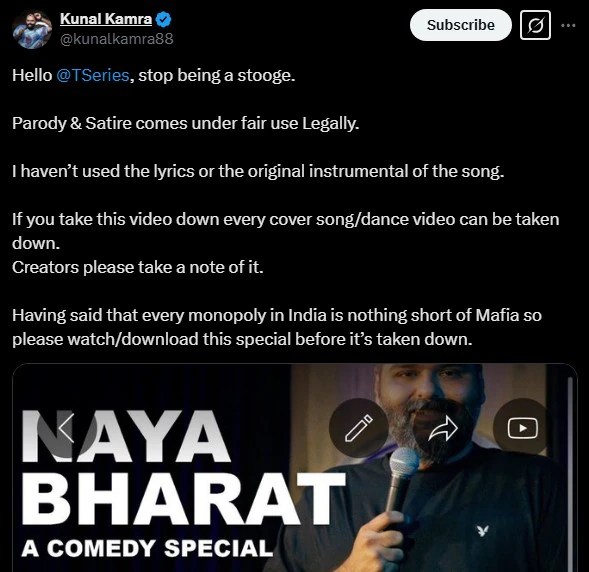
What happened?
In March 2025, comedian Kunal Kamra released Naya Bharat, a satirical comedy video that used iconic Bollywood tunes like “Hawa Hawai” and “Bholi Si Surat” to deliver biting political commentary. The video struck a chord with many but also a nerve with some. It quickly gained traction and was just as quickly taken down, reportedly following copyright claims by music label T-Series.
This brings up a pressing legal question: was Kamra’s musical satire an act of copyright infringement, or is it protected under the fair dealing doctrine?
Why is it controversial? Understanding the allegations
Though no official complaint has been made public, the takedown suggests possible allegations of:
- Unauthorized use of copyrighted musical compositions,
- Adaptation through rewritten lyrics,
- Breach of YouTube’s Content ID rules.
At the core of this controversy lies a deeper debate: does political satire, particularly when using popular melodies, fall under legal exceptions to copyright? (At the outset, I clarify that Kunal’s take that parody and satire definitely come under fair legal use is incorrect.)
How does the Indian copyright law treat parody and satire?
India follows a stricter “fair dealing” doctrine, codified under Section 52 of the Copyright Act, 1957. This lays out a specific list of scenarios, like private research, criticism or review, reporting of current events, education, or judicial proceedings, where copying isn’t considered infringement. Unlike fair use, this list is exhaustive, not illustrative. That means if your purpose isn’t on the list, you’re likely out of luck.
In practice, the lack of clear legal guidelines on permissible usage and on fair use means its application often hinges on case-by-case judicial interpretation such as whether Kamra’s altered lyrics and borrowed melodies were used to critique the originals or merely to attract attention, and whether his work transformed the source material enough to qualify as protected parody rather than commercial exploitation.
Fair dealing in India does not permit full reproduction of content but the use of brief excerpts accompanied by commentary, criticism, or for news reporting is generally considered non-infringing.
In the present case of parody and satire, though it’s not mentioned by the statute, Indian courts have read it into fair dealing. Let’s have a look at some landmark Indian cases.
In India TV v. Yashraj Films1 [“India TV“], satirical film clips used in a news segment were allowed as criticism. The court reaffirmed that humorous or mocking critique still qualifies as transformative use. It also held that the use of film clips in a satirical news segment did not harm the market for the original songs or films, because the purpose was criticism and commentary, not entertainment or substitution. The court emphasized that transformative and critical use, even if it involves recognizable works, does not compete with or replace the original in the market.
In Civic Chandran v. Ammini Amma2 [“Civic Chandran“], a play that parodied a popular drama in the form of a counter-drama was challenged for infringement. The court upheld the parody as fair dealing, stressing the need to protect ideological and political critique. The relevance of these precedents is that they show that parody, especially of a political nature, is legally permissible, even without express mention in the statute.
Similarly, Kamra’s satirical video Naya Bharat appears to have been created primarily for the purpose of political critique. Like the counter-drama in Civic Chandran, his work reproduces parts of well-known songs to anchor his criticism. The use of iconic Bollywood melodies arguably served as a deliberate contrast to the serious political content, amplifying the satirical tone. While Kamra may have earned revenue through platform monetization, courts have held that commercial gain alone does not negate a fair dealing defense, especially when the work is transformative and the borrowed elements serve a critical and arguably necessary expressive function. Additionally, Kamra’s work does not function as a substitute for the original songs “Hawa Hawai” or “Bholi Si Surat.” No reasonable viewer would watch Naya Bharat instead of listening to the original Lata Mangeshkar rendition. The video’s goal is to politically critique the “New India,” not to replicate or redistribute the entertainment value of Bollywood hits. Thus, Naya Bharat does not threaten T-Series’ market or licensing interests in any meaningful sense—reinforcing its claim to fair dealing.
How does U.S. law help clarify the issue?
The U.S. adopts a more flexible “fair use” doctrine under Section 107 of its Copyright Act, 1976, which allows for the reproduction of copyrighted work to a certain degree (often limited), in order to protect public interest, while balancing the rights of the holders. It is non-exhaustive and evaluated on a case-by-case basis using four fairness factors:
1. Purpose and character of the use (whether it’s commercial or transformative);
2. Nature of the copyrighted work;
3. Amount and substantiality used;
4. Effect on the potential market or value of the work.
Let’s look at both supportive and restrictive landmark cases. In Campbell v. Acuff-Rose Music, Inc.13, the rap group 2 Live Crew created a parody of Roy Orbison’s 1964 hit “Oh, Pretty Woman.” They used the song’s distinctive bassline and opening lyrics but altered the rest of the track to include humorous and sexually explicit content. Despite being denied permission by the copyright owner, Acuff-Rose Music, 2 Live Crew released the parody commercially. The U.S. Supreme Court ruled in favor of 2 Live Crew, holding that the parody constituted fair use, as it was transformative, offered social commentary, and did not harm the original song’s market. The court emphasized that even commercial use could qualify as fair use if it added new meaning or expression. Additionally, the court here also clarified that a parody is unlikely to usurp the market for the original work because it serves a different purpose – commentary rather than entertainment. This case supports Kamra’s defense. Like 2 Live Crew, he rewrote lyrics to comment on broader themes (here, political critique), using only what was necessary to evoke the original.
However, in MGM v. Honda4, a James Bond-like ad using similar music was ruled not fair use because it didn’t critique the original, it merely borrowed style and fame for commercial appeal. This case shows that just invoking a familiar work without clear critique of the original can weigh against fair use. If Kamra’s video had simply used Bollywood songs to gain attention without commenting on the original songs or offering political critique, this precedent would cut against him. However, Kamra’s lyrics clearly transformed the meaning of the songs into pointed political commentary, unlike Honda’s advertisement, which only borrowed the “coolness” of Bond without satire.
How does Rule 23 fit in?
Some may argue that Kamra should have complied with Rule 23 of the Copyright Rules, which governs cover versions. However, I argue that the rule applies to musical renditions or adaptations for performance, not necessarily to transformative parody for critique. If the parody qualifies as criticism, the rule may not apply. Moreover, Rule 23 cannot override Section 52 exceptions.
What’s the verdict? Infringement or commentary?
In my opinion, Kamra’s Naya Bharat is:
- Transformative: It rewrites lyrics to generate new, critical meaning.
- Non-substitutive: Viewers won’t confuse it with the original songs.
- Proportionate: It uses only what’s necessary to deliver the commentary.
- Aimed at critique: It engages in social and political criticism.
- Minimal market impact: It is unlikely to affect the market value or audience for the original songs—consistent with Indian and international judicial reasoning.
All this brings it within the fair dealing exception under Section 52(1)(a)(ii) of Indian copyright law and fair use under U.S. law. Far from infringing, Naya Bharat is a legally permissible expression of political dissent through art.
The Copy That! View
Kunal Kamra’s Naya Bharat likely qualifies as fair dealing under Indian copyright law. It is transformative, critical, and proportionate in its use of original material. Indian precedents such as Civic Chandran and India TV, along with international cases like Campbell, support the view that parody is not merely derivative, but a legitimate and protected form of political expression. Moreover, in Ashutosh Dubey v. Netflix5, the Delhi High Court recognized that stand-up comedians often exaggerate for effect, and their work is generally understood as satire rather than statements of fact. This reinforces the idea that political satire should be viewed through a lens of creative expression, not literal infringement.
That said, Kamra’s legal position – while hopeful, is not without vulnerabilities. Indian law lacks an explicit exception for parody, and enforcement mechanisms on platforms often bypass fair dealing analysis. As the Civic Chandran judgment also noted, the permissible extent of copying depends on context, with no hard-and-fast rule to guide creators. Until Indian law expressly recognizes parody as a protected form of critique, works like Naya Bharat will remain at risk, walking a legal tightrope between creative expression and censorship.
- India TV Independent News Service Pvt. Ltd. & Ors. v. Yashraj Films Pvt. Ltd. (2013 (53) PTC 586 (Del)) ↩︎
- Civic Chandran and Ors. v. C. Ammini Amma and Ors., 1996 PTC 670 (Ker HC) 675-677 ↩︎
- Campbell v. Acuff-Rose Music, 510 U.S. 569 (1994). ↩︎
- Metro-Goldwyn-Mayer, Inc. v. Am. Honda Motor Co., Inc., 900 F. Supp. 1287 (C.D. Cal. 1995) ↩︎
- Ashutosh Dubey v. Netflix, MANU/DE/1008/2020 ↩︎
 copythatbyk.com